

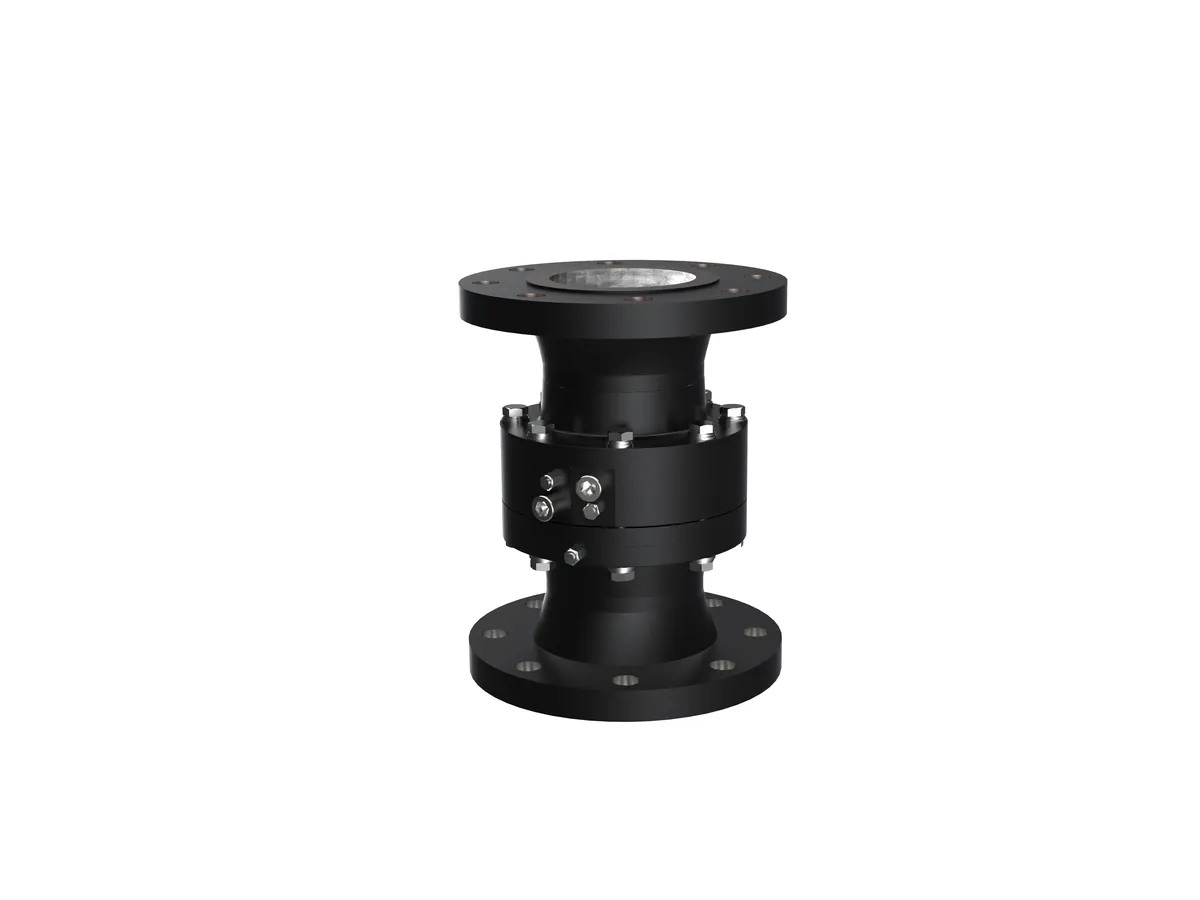
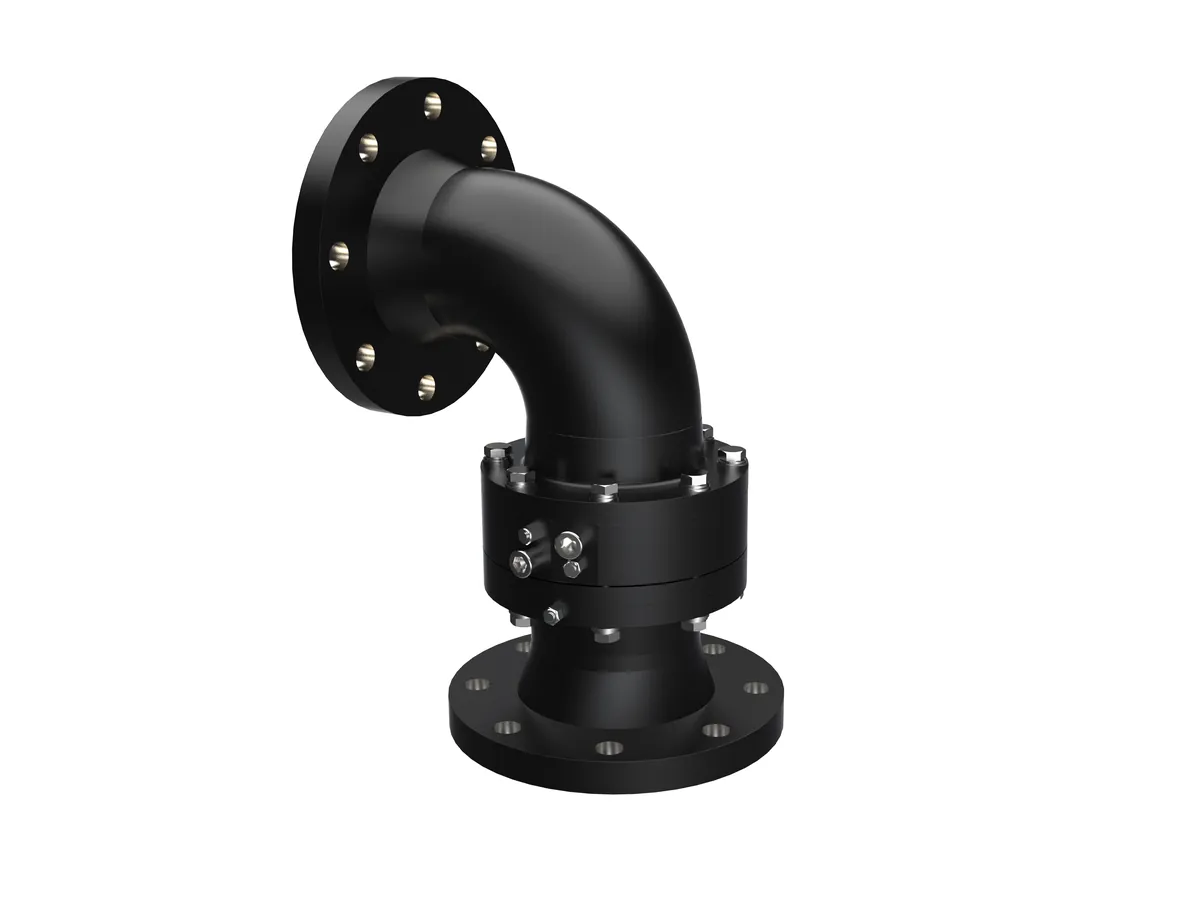
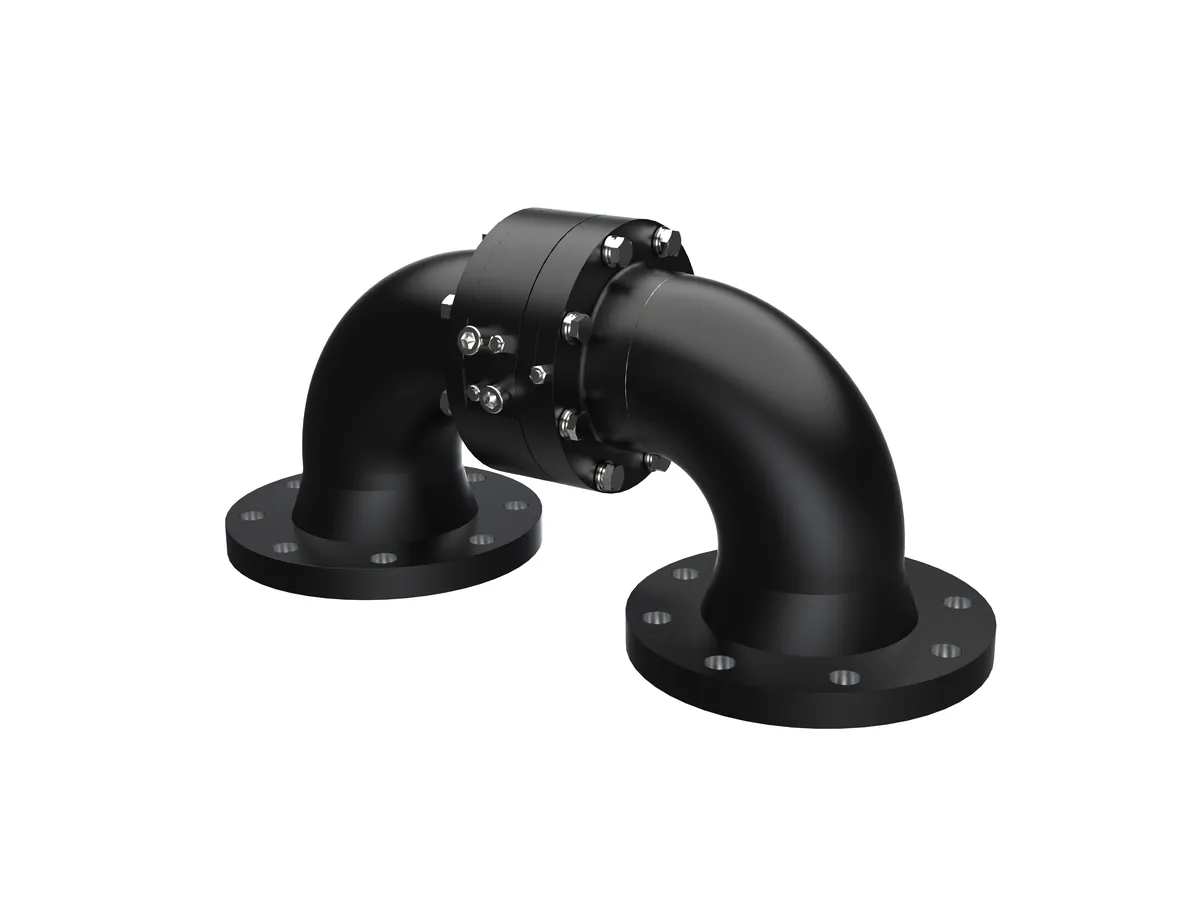
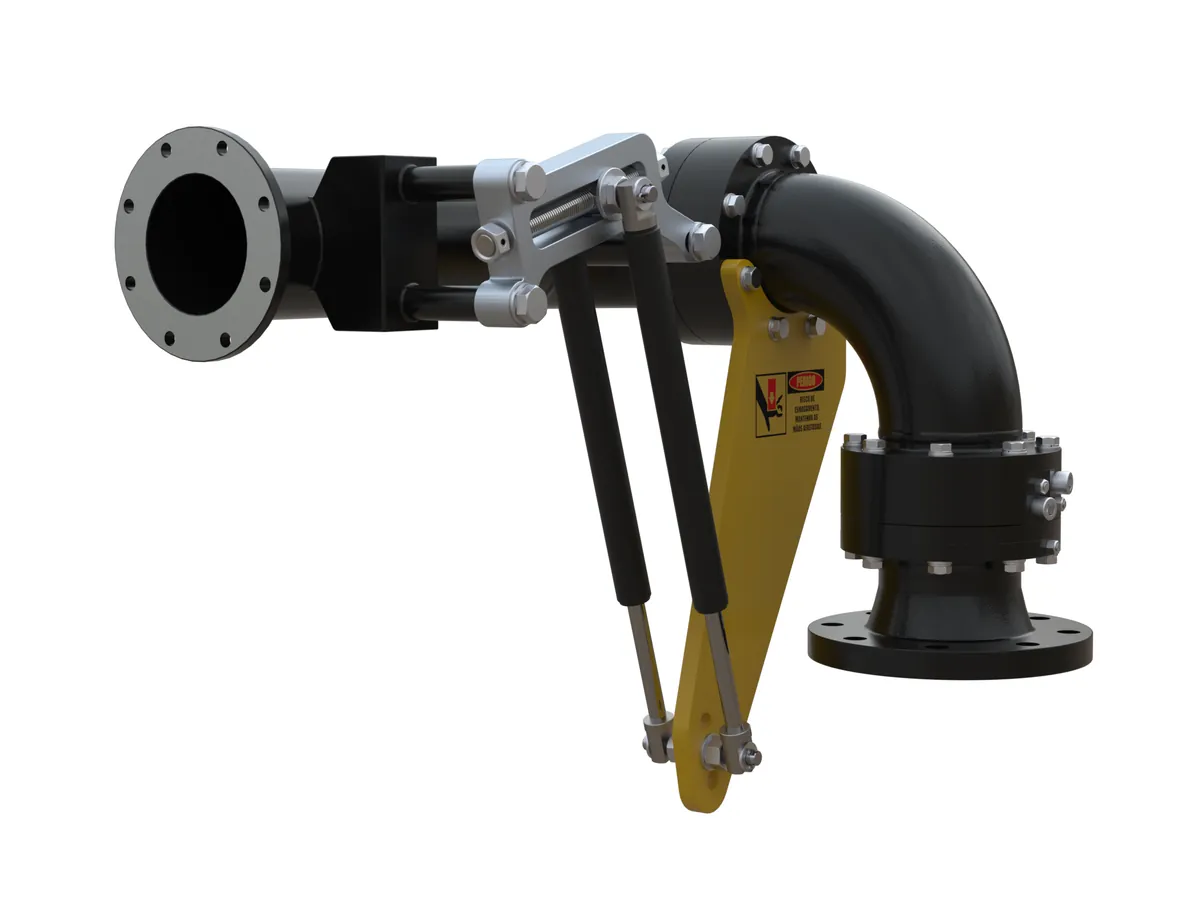
TSPRO Modular Rotary Joints were developed to allow rotational movement of loading arms, hoses, and pipes without compromising line tightness. Their modular construction allows for the combination of different rotation modules, bends, rotation planes, and end types. This flexibility allows the equipment to be configured according to the movement required by the installation and also facilitates its use in replacing joints installed in arms from different manufacturers. This page also highlights the interchangeability for replacement in other arms. The assembly has double sealing, creating a second containment barrier in case the primary seal shows wear. An external indicator signals this condition before the product reaches the environment, allowing maintenance to be scheduled without the need to immediately interrupt the equipment. The rotation module has a three-part construction with a double flange. To access and replace the seals, simply remove the screws from the assembly, without disassembling or removing the balls from the rotation track. This configuration reduces the time and cost of maintenance interventions. Another differentiating factor is the electrical continuity incorporated into the design, developed to maintain the electrical connection between the parts of the joint during its movement. The technology has a patent pending under number BR 10 2018 073470-9. With a robust structure and a rotating track designed for industrial applications, the joints withstand the stresses associated with arm movement and contribute to a longer service life. They can be supplied in different diameters, materials, seals, and connection configurations.
The code includes the mounting style, both ends, diameter, seal, and material.
In the example JM20AT-42C: JM20 is the mounting style 20; A and T are the end types (ANSI flange and TTMA flange); 4 is the 4-inch tubing; 2 is the Viton seal; and C is the carbon steel.
Mounting styles range from 20 to 70, and the choice defines the planes of rotation and curves of the assembly.
Diameters range from 2 to 10 inches (2, 3, 4, 6, 8 and 10), in carbon steel, aluminum or 304 and 316 stainless steel.
The ends can be beveled for welding, BSP or NPT threaded, TTMA flange, plain square flange, square flange with O-ring groove, or ANSI flange. The seals are Buna-N, Viton, or PTFE.
Aluminum bends are cast and can be smooth, with a handle, or with a knob.
The hydrostatic test is performed at 128 psi (9 kgf/cm²), except at weld-type ends.
Welding is performed by qualified welders, and the carbon steel components receive standard TSPRO black paint.
| Application | Loading arms, hoses and pipes |
| Diameters | 2”, 3”, 4”, 6”, 8” and 10” (2” to 10”) |
| Materials | Carbon steel / aluminum / 304 stainless steel / 316 stainless steel |
| Seals | Buna-N, Viton or PTFE |
| Extremities | Welding, threading, ANSI flanges, TTMA flanges, or square flanges. |
| Hydrostatic test | 128 psi — 9 kgf/cm², depending on the configuration. |
| Electrical continuity | Guaranteed by Patent BR 10 2018 073470-9 |
Our engineering team provides support from the initial sizing to defining the ideal model