


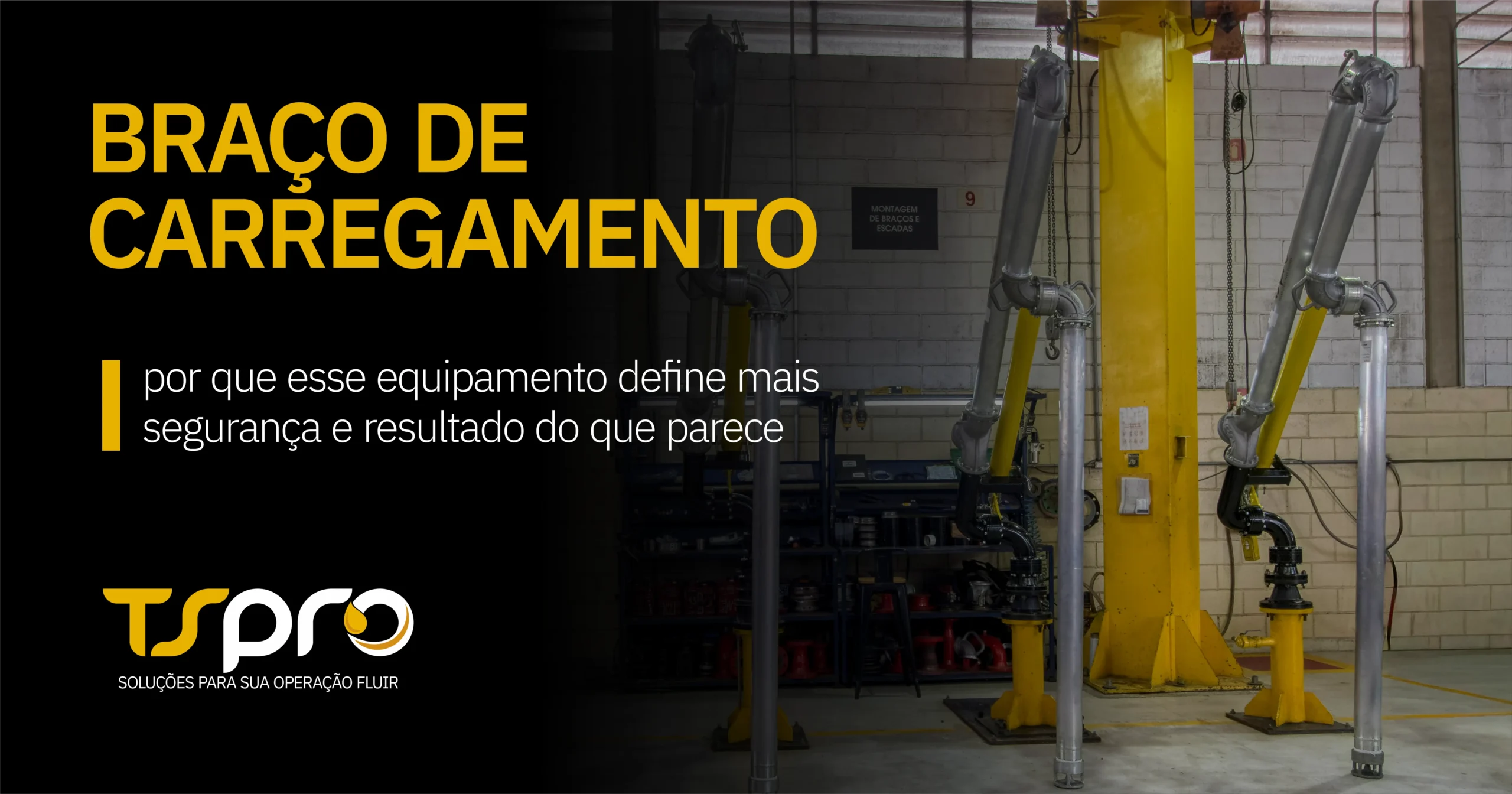
Loading arm: what it is, how it works, and why it impacts the safety and cost of the operation.
The loading arm is one of the main pieces of equipment used for the safe transfer of liquids between tanks, tank trucks, railcars, and industrial systems. Although it often goes unnoticed in day-to-day operations, its specification directly influences safety, productivity, asset availability, and total cost of operation.
When properly designed, installed, and maintained, a loading arm reduces the risk of leaks, facilitates operation, and increases the reliability of industrial processes. Conversely, inadequate or poorly specified equipment can lead to unplanned downtime, high maintenance costs, and increased exposure to environmental hazards.
What is a loading arm?
A loading arm is a mechanical device designed to transfer fluids between a process pipeline and a loading or unloading point, such as:
- Tanker trucks;
- Railway wagons;
- Storage tanks;
- Ships and vessels;
- Other industrial transfer systems.
Unlike conventional hoses, the loading arm offers greater stability, operational control, safety, and service life, making it suitable for applications involving flammable products, chemicals, fuels, and other critical fluids.
How does a loading arm work?
The operation of the loading arm is based on a set of mechanical components that allow for controlled movement and safe transfer of the product.
Its main elements include:
- Structural piping;
- Rotary joints;
- Counterbalancing system;
- Seals;
- Coupling devices;
- Drainage and safety systems.
These components work together to allow the operator to position the equipment precisely, maintaining the seal throughout the loading or unloading operation.
In more advanced equipment, such as that developed by TSPro, rotary joints feature double sealing, a wear indicator, and modular construction, reducing maintenance time and increasing operational availability.
Why is the loading arm important for safety?
Operational safety depends on several factors, and the loading arm plays a fundamental role in this process.
In addition to ensuring a more stable transfer, it contributes to:
- Reducing the risk of leaks;
- Greater control over equipment movement;
- Improved ergonomics for the operator;
- Electrical continuity during operation;
- Reduced exposure to environmental accidents.
In operations involving flammable liquids, electrical continuity is especially important for dissipating electrostatic charges generated by the product flow, reducing the risk of ignition.
Another important feature is the use of double sealing with a wear indicator, allowing the need for maintenance to be identified before a leak occurs.
The impact of the loading arm on the cost of operation.
Many companies evaluate a loading arm solely based on its purchase price. However, the greatest financial impact typically occurs during its use.
Total cost of ownership (TCO) includes factors such as:
- Maintenance time;
- Availability of spare parts;
- Frequency of interventions;
- Operation downtime;
- Product losses due to leaks;
- Environmental and compliance costs.
Equipment designed to facilitate maintenance and reduce corrective interventions offers greater operational predictability and lower costs throughout its lifespan.
Features that make a difference in a loading arm.
Not all loading arms offer the same operational performance. Certain design features contribute significantly to increasing the system's reliability.
Among the most important features are:
- Three-part rotary joints;
- Double seal;
- Seal wear indicator;
- Standardized market seals;
- Counterbalancing system using a compression spring;
- Ease of maintenance;
- Improved ergonomics during operation.
These differentiating factors reduce repair time, facilitate preventive inspections, and increase equipment availability.
More than just a piece of equipment, a strategic decision.
Choosing a loading arm is not just a technical decision. It's also a decision that affects productivity, safety, and profitability.
When equipment offers greater reliability, lower maintenance needs, and reduced operational downtime, the entire production chain benefits.
Therefore, managers, engineers, and specifiers must evaluate not only the initial investment but also the expected performance throughout the equipment's entire lifecycle.
How to assess if your operation is prepared
Before specifying or replacing a loading arm, it's worth answering a few questions:
- Can wear and tear be identified before a leak occurs?
- Can maintenance be performed quickly?
- Are spare parts readily available?
- Does the equipment offer good balance and ergonomics?
- Does the system have reliable electrical continuity?
- Was the project developed to facilitate preventive inspections?
Answering these questions positively means reducing operational risks and increasing the availability of the industrial plant.
Conclusion
The loading arm is a strategic piece of equipment for industrial operations that require safety, efficiency, and reliability in fluid transfer.
When specified correctly, it reduces leaks, facilitates maintenance, improves operator ergonomics, and lowers the total cost of ownership over the years.
When evaluating new equipment, consider not only the purchase price, but also factors such as ease of maintenance, parts availability, quality of rotary joints, sealing systems, and operational performance. This analysis contributes to safer, more predictable, and economically sustainable operations.