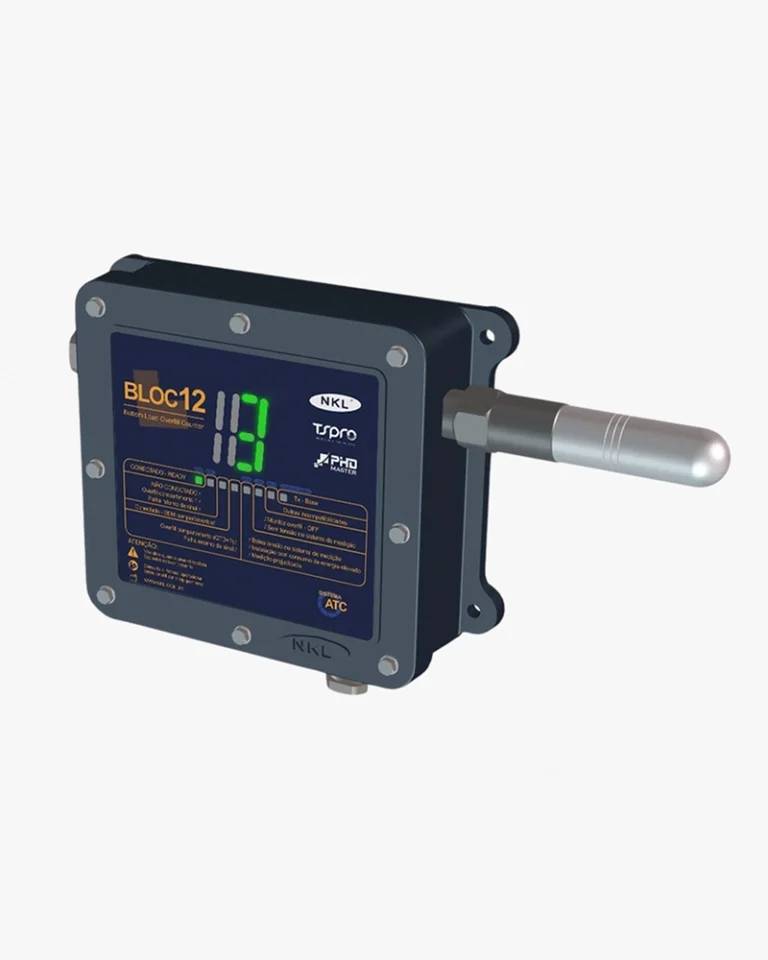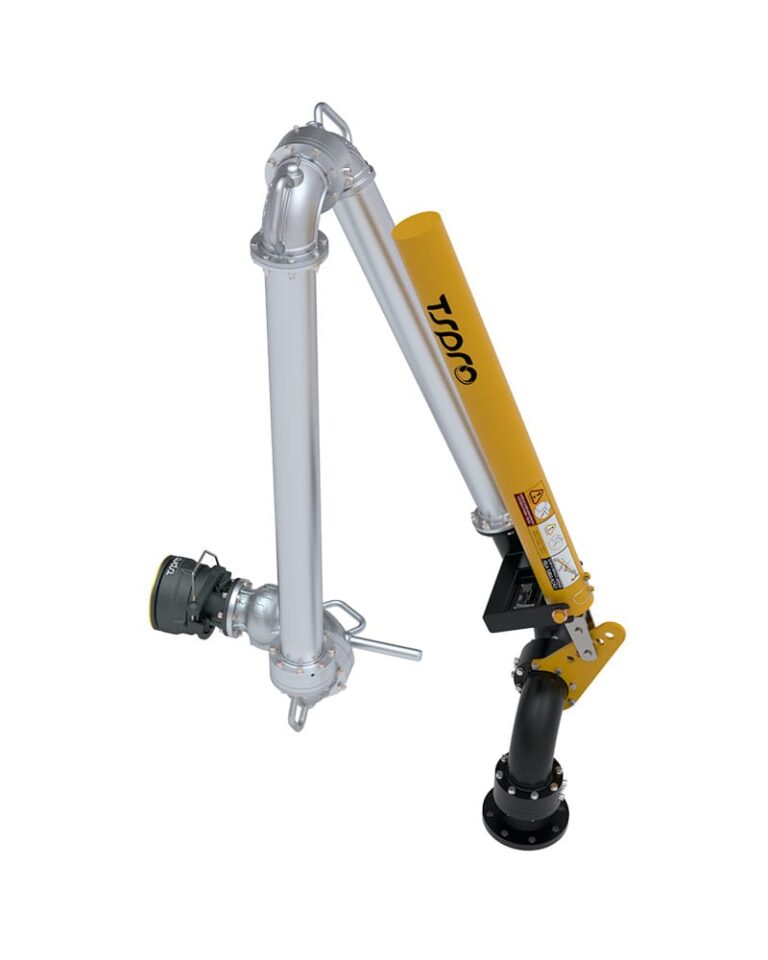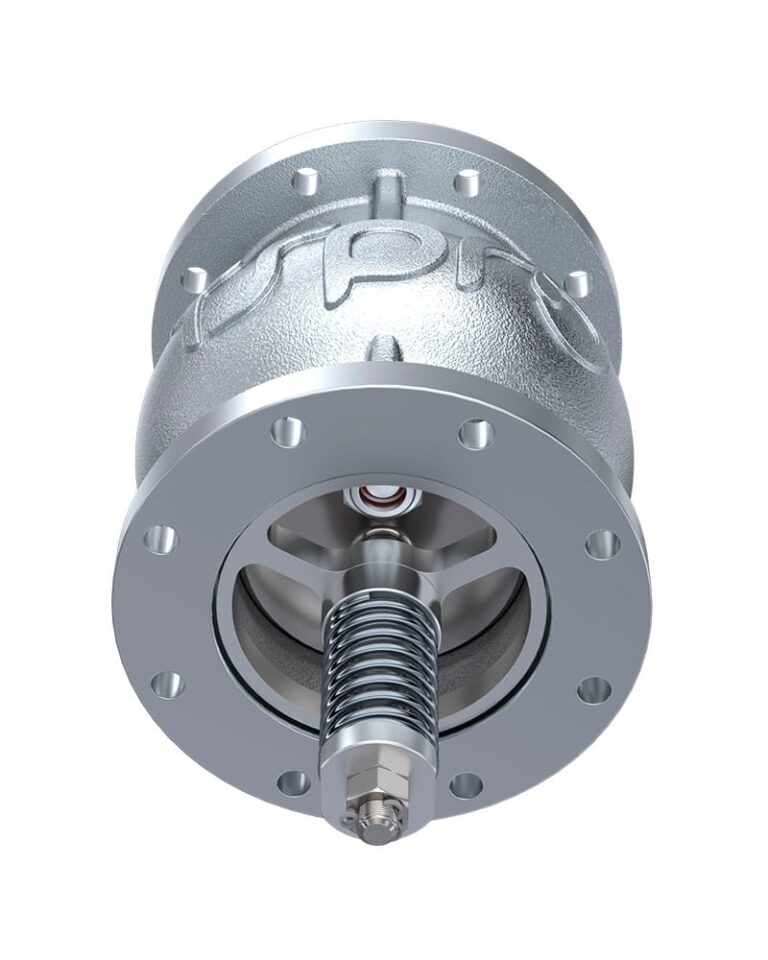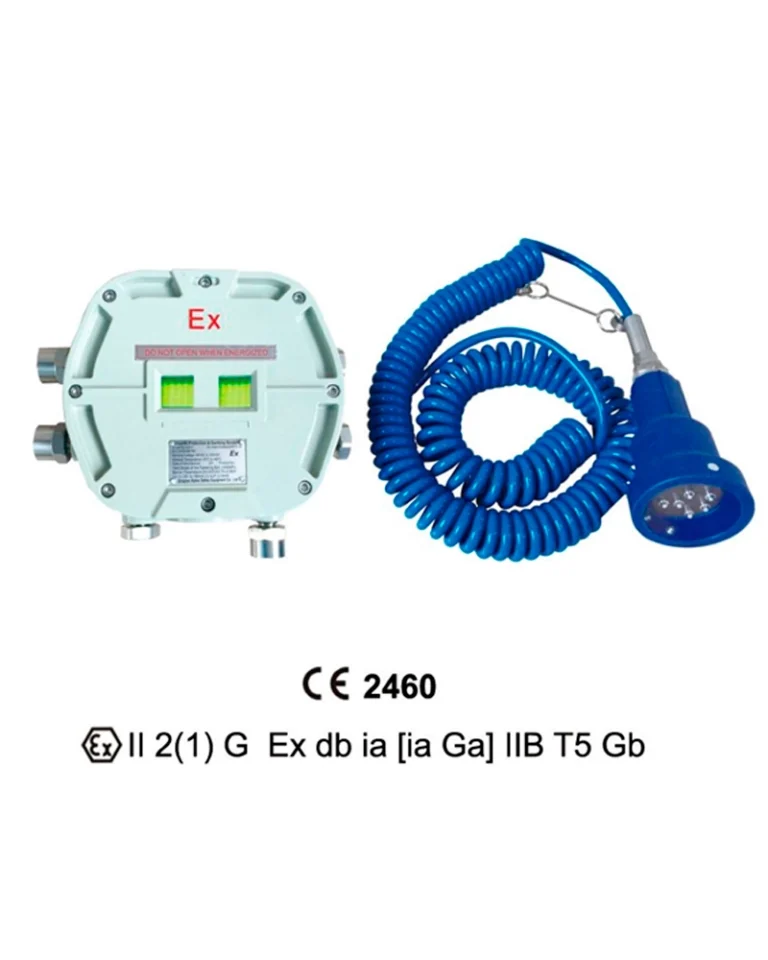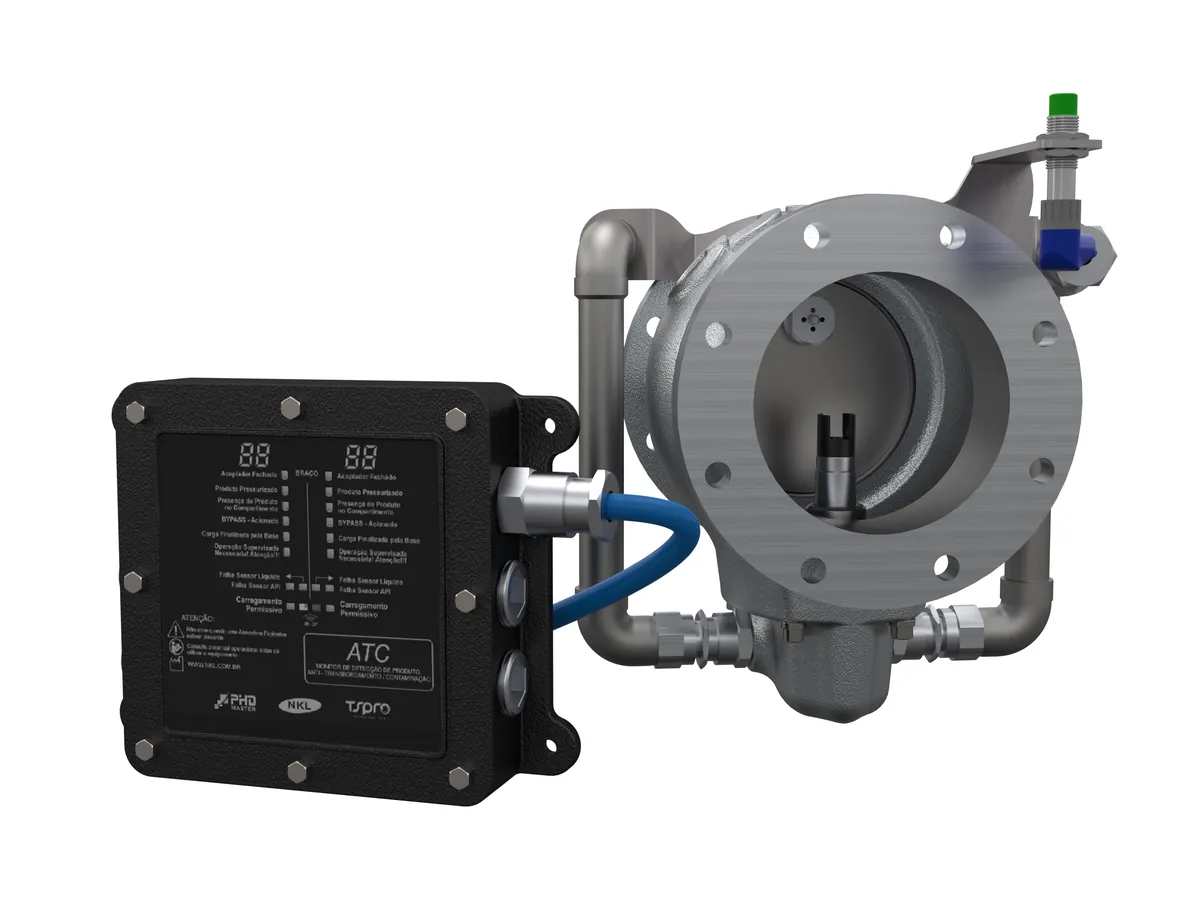
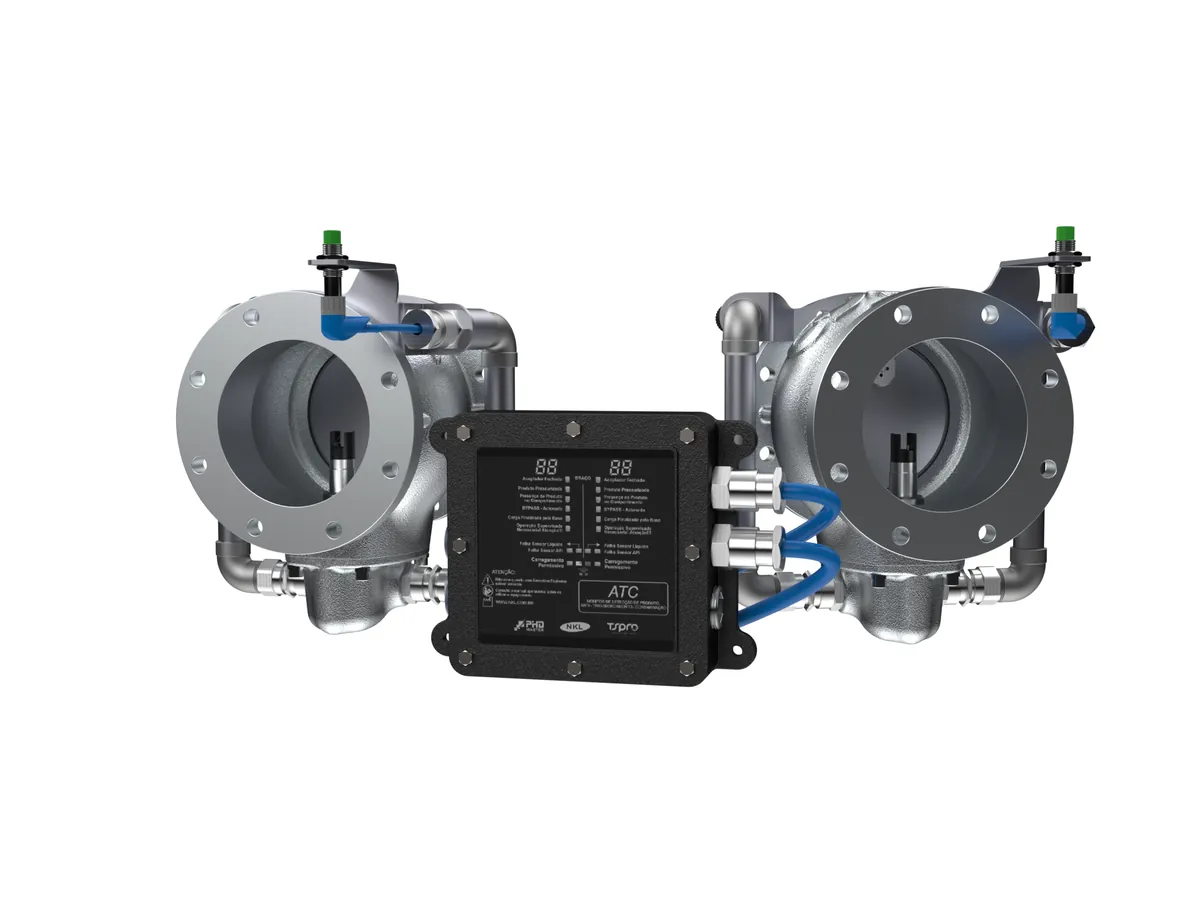
The ATC System — Anti- Overfill and Contamination — was developed to increase safety in Top and Bottom Loading operations, acting preventively on situations that a conventional overfill system may not identify on its own. The solution allows for the detection of remaining product, validation of the vehicle and the connected compartment, comparison of tank capacity with the programmed volume, and diagnosis of faults or irregularities in the overfill sensors. In this way, loading can be blocked before an unsafe condition results in spillage, product mixing, or incorrect loading. In the Bottom Loading configuration, the ATC Check Valve detects the presence of liquid in the truck's piping, regardless of operator action, and prevents loading when it identifies remaining product. The RFID wand provides power to the valve, communicates with the ATC Scan, and can identify tags installed on API nozzles. RFID tags store information such as vehicle license plate, identification, and compartment capacity. This data can be compared with the terminal programming, reducing the risk of connecting to the wrong compartment or loading a volume exceeding the available capacity. The system can also incorporateBLOC12, responsible for counting and diagnosing overfill sensors, and ATC Scan, which centralizes information from field equipment and makes it available to the supervisory system via Modbus protocol. The solution can be provided partially or completely, according to the structure and needs of each installation.
Starting from 4 liters of any liquid retained in the truck's piping.
This prevents the shipment from being released if there is product residue or if the load is attached to the wrong compartment, thus avoiding contamination and overflow.
No: it is a fully automatic electromechanical system, installed on the loading arm.
It complements the existing overfill system and features self-checking, which displays any abnormalities on the panel. There is also a bypass for supervised loading with a security key and an anti-theft function that prevents the draining of fuel retained in the vertical section of the arm.
Through dry output relays, which communicate with any existing preset or automation system.
The panel monitors up to 2 independent loads, has a dual voltage power supply (12 to 24 V DC) and IP54 protection. The electronic components are INMETRO certified for explosive atmospheres.
| Application | Top Loading and Bottom Loading |
| Architecture | Modular and expandable |
| Identification | RFID technology |
| Communication | Bluetooth and Modbus |
| Integration | TAS, PLC or supervisory system |
| Main modules | ATC Valve, RFID Stick, RFID Tags, BLOC12 and ATC Scan |
Our engineering team provides support from the initial sizing to defining the ideal model