


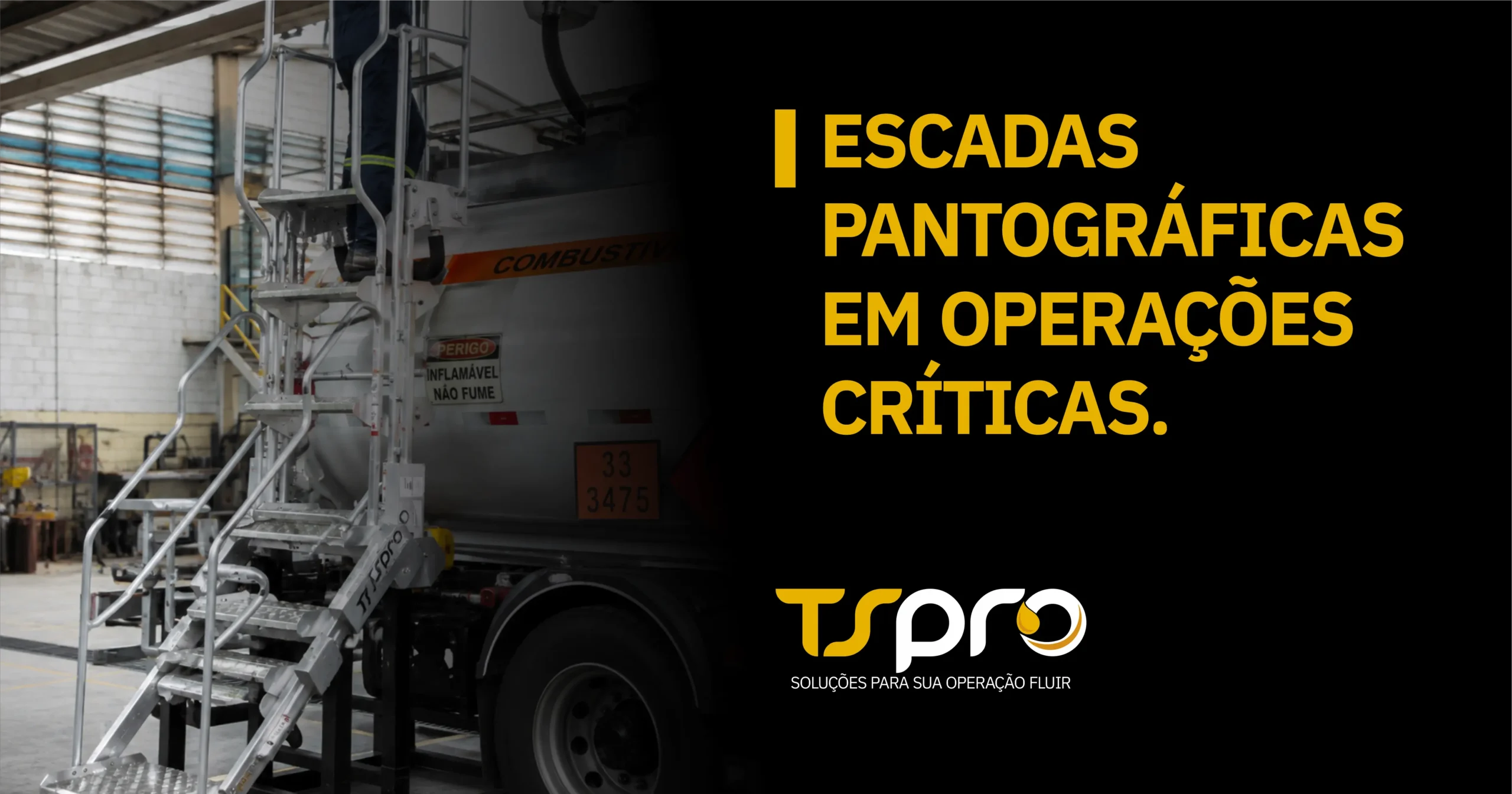
Pantograph ladders in critical operations: why the technical decision needs to go beyond the initial price.
In many industrial operations, there is still a tendency to treat access equipment as peripheral items. The logic seems simple: if the ladder fulfills the function of allowing access to the top, then the main selection criteria would be price, size, or immediate availability.
But this reading is short.
In operations involving fuels, chemicals, and other hazardous fluids, access to the top of tanker trucks and railcars is a critical step. It is at this point that operator safety, ergonomics, structural integrity, and operational reliability must work together. When the specification ignores this context, the equipment ceases to be a solution and becomes a recurring source of operational friction.
This is an important topic because many of the problems that arise in the field don't begin during use. They begin with how the technical decision was made.
When the choice is based solely on the initial investment, crucial factors are left out: exposure to corrosion, frequency of use, handling effort, maintenance needs, and the suitability of the system to the operational reality.
In practice, this means that equipment that appears more economical can become more expensive over time. And not just financially. It can cost you in terms of predictability, availability, operational comfort, and safety margin.
That is precisely why the debate between carbon steel and aluminum needs to be conducted with more maturity.
Carbon steel still appears in many applications due to market tradition. However, in harsh environments, its long-term behavior tends to impose a routine of maintenance and preservation that weighs on operations. Structural corrosion, recurring interventions, and loss of performance are not minor details. They are signs of a technical decision that may have been oversimplified.
Aluminum, on the other hand, gains relevance when the analysis criteria evolve. It makes sense because it responds better to contexts where corrosion, ergonomics, and operational continuity need to be taken seriously. Instead of looking only at the purchase price, the analysis begins to consider the total cost of operation.
And this point deserves emphasis: total cost is not a sales pitch. It's an engineering criterion.
When a piece of equipment reduces maintenance needs, facilitates handling, better preserves its structural condition, and sustains more predictable use in a real-world environment, it changes the decision-making pattern. The focus shifts from a superficial price comparison to a more responsible analysis of performance over time.
In the case of pantograph stairs, this perspective needs to be accompanied by other equally important criteria.
Safety, for example, cannot be understood as an isolated attribute. It depends on a coherent set: conformity, design, stability, resistance, protective features, suitable flooring, and compatibility with the application. The same applies to ergonomics. In high-frequency operations, weight and ease of movement are not conveniences. They are factors that directly influence the routine and the risk.
It is also important to overcome some common market objections. One of them is the perception that aluminum is, by definition, less resistant than carbon steel. In mature technical decisions, this type of simplistic comparison loses ground. What needs to be evaluated is the equipment design, the structure, the application, and the behavior of the assembly in real-world use.
Another frequent objection is the excessive focus on acquisition cost. This is perhaps the most common—and the most dangerous. Because it leads to decisions that seem economical in the short term, but exact their price in maintenance, downtime, and operational wear and tear in the medium and long term.
Ultimately, the central issue is this: in critical operations, a scissor ladder should not be treated as a generic access device. It is part of the engineering that supports safety, continuity, and predictability.
When this change occurs, the equipment is no longer viewed in isolation and begins to be understood within the context that truly matters: application, risk, operational routine, maintenance, and long-term performance.
This is how a seemingly simple choice transforms into a better technical decision.
If your operation is reviewing top access criteria for tank trucks, railcars, or loading platforms, it's worth deepening the analysis before the next specification. The right decision starts with the application context.
If your operation needs to raise the technical standard of its access solutions, it's worth taking a closer look. Learn about our scissor lift stairs.
Contact us: https://tspro.com.br/produtos/escada-pantografica/
#AccessEngineering #OperationalSafety #PantographicLadder #CriticalOperations #TotalCostOfOperation #StructuralIntegrity #IndustrialErgonomics #OperationalReliability #HarshEnvironments #TechnicalDecision