


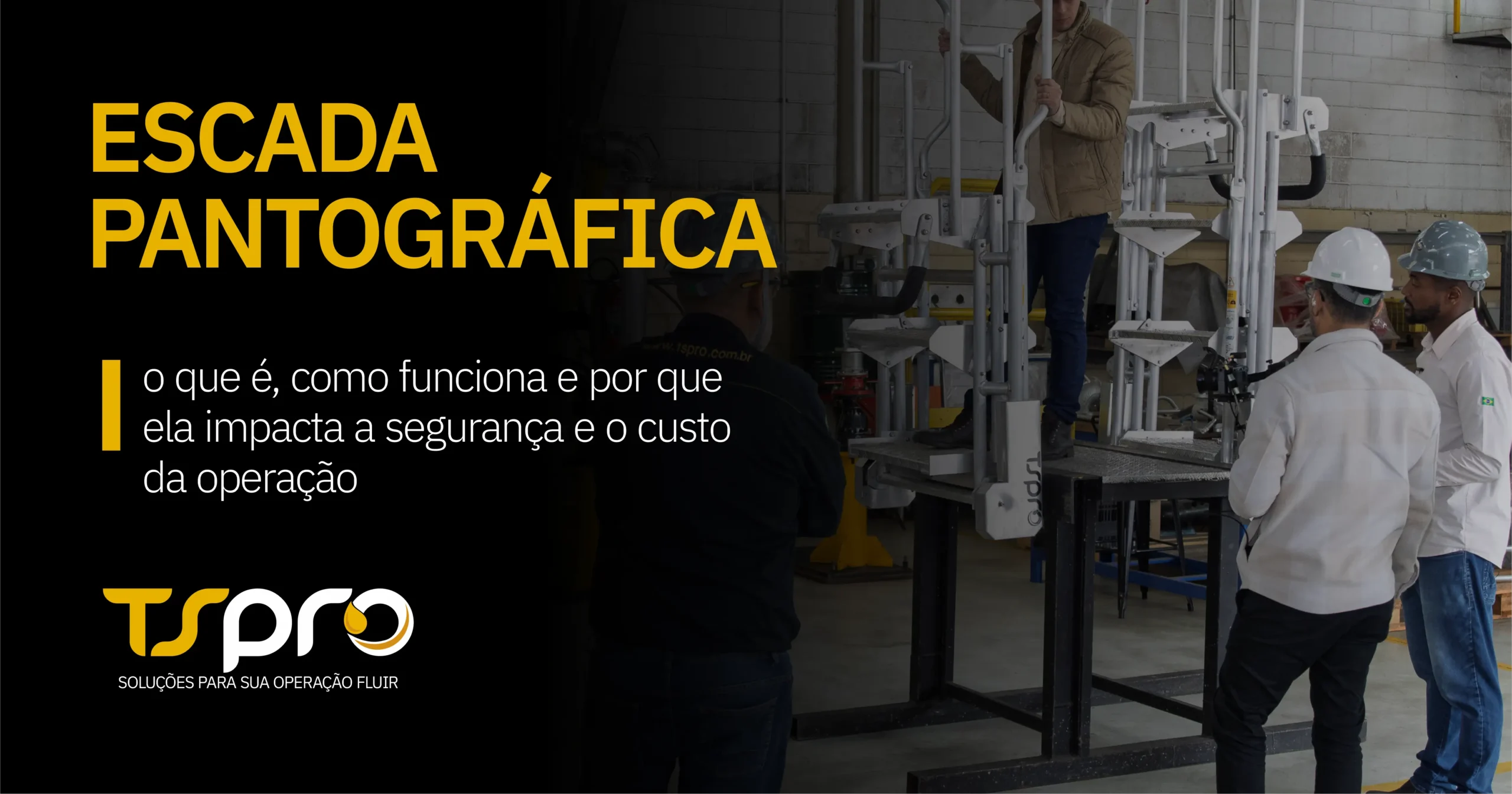
Pantograph ladder: what it is, how it works, and why it impacts the safety and cost of the operation.
In many industrial operations, the scissor lift only gains attention when access to the top begins to create friction in the daily routine. A point of corrosion, difficulty in handling, increased maintenance requirements, or a more evident operational risk are enough to show that this equipment is far from being just a detail of the platform. In practice, the scissor lift directly impacts operator safety, access ergonomics, environmental resistance, maintenance needs, and operational predictability over time. When the solution is correctly specified, installed, and used, it contributes to a more stable, safer routine, less exposed to improvisation. When treated as a generic item, it can become a recurring point of wear and tear, hidden costs, and loss of predictability.
What is a pantograph ladder?
The pantograph ladder is a piece of equipment designed to allow safe access to the top of tank trucks and railcars from the loading platform. Its role is to create a safer, more stable, and operationally coherent solution for activities where top access is part of the loading and unloading routine. At TSPro, the pantograph ladder is used in operations with fuels, chemicals, and other critical contexts where safety, lightness, mechanical resistance, and low corrosion exposure make a concrete difference in the operation.
How does a pantograph ladder work?
In short, a scissor lift creates a mobile access structure between the platform and the top of the vehicle. Its operation must combine stability, ease of movement, grip during use, and safety for the operator during routine tasks. This solution can incorporate features such as non-slip flooring, anti-crushing systems, contact stops, and optional extras that enhance the lift's suitability for different applications. The expected result is safer access, improved usability, and reduced risk during frequent operations.
Why does aluminum change the reading of the solution?
In the case of the TSPro pantograph ladder, the fact that the solution is constructed from aluminum is not merely a catalog feature. It's a technical decision with a direct impact on operation. In many industrial environments, especially those with humidity, severe exposure, sea air, or intense use, the construction material directly influences durability, maintenance needs, and performance stability over time. This is where aluminum becomes relevant. Aluminum construction helps reduce exposure to corrosion, one of the factors that most compromise the reliability of equipment installed in aggressive environments. This means less tendency for structural degradation associated with the environment and, consequently, less pressure on corrective maintenance and premature replacements. Another important point is lightness. A lighter ladder tends to improve ergonomics, reduce operational effort, and make the routine more fluid for those who need to move and use the equipment frequently. In critical operations, ergonomics is not a detail. It is part of the safe performance of the solution. There is also a third relevant factor: in certain applications, aluminum also reinforces the safety perception because it is a non-sparking material, which increases its suitability in sensitive environments and helps support a more technical, mature decision that is more aligned with the operational context. Therefore, when TSPro works with aluminum pantograph ladders, the argument should not be interpreted simply as "a different material." It should be understood as part of a solution focused on durability, ergonomics, safety, and operational predictability.
Why does this equipment interfere so much with the safety of the operation?
In operations involving hazardous fluids, safety depends not only on the main process but also on the equipment that supports the surrounding routine. The scissor lift ladder is a crucial element here. It influences access stability, operator effort, fall risk, equipment behavior in aggressive environments, and adherence to applicable safety requirements. Therefore, safety in scissor lift ladders should not be treated as an isolated attribute. It depends on the combination of design, construction materials, flooring, mechanical protection, dimensional adequacy, and technical compliance.
Compliance with NR-12: why does it matter?
In the case of pantograph ladders, compliance with NR-12 (Brazilian Regulatory Standard 12) needs to be understood as part of the solution's safety logic, and not as a mere formality. When the operation involves access to the top in critical industrial contexts, talking about compliance means talking about more consistent criteria for protection, use, and reliability. Adherence to NR-12 requirements helps support a more mature understanding of the specification, reinforcing that safety should not be resolved through adaptation or improvisation in the field. In practice, this strengthens the perception that the ladder needs to be evaluated not only by reach or price, but also by its coherence with an operational environment that demands method, protection, and predictability.
The hidden cost of a poorly specified staircase.
Often, the problem doesn't appear in the budget as a "ladder failure." It shows up in the daily routine, in the form of corrosion, corrective intervention, operational discomfort, the need for premature replacement, rework, or increased risk exposure. This is why the pantograph ladder is rarely perceived as the source of the problem until the operation is already paying the price. This reasoning changes the decision-making process. Instead of looking only at the purchase price, the analysis begins to consider the total cost of operation: environmental resistance, maintenance needs, frequency of intervention, safety in use, ergonomics, and predictability over time.
What characteristics make a difference in practice?
Not all scissor lifts deliver the same level of operational performance. Construction features make a real difference in daily use. Among the most important attributes are:
- aluminum construction;
- less exposure to corrosion;
- operational ease;
- anti-crushing system;
- Non-slip flooring;
- rubberized bumper;
- compliance with NR-12;
- suitability for real-world application.
In practice, this means more stability in the routine, less effort required for use, less friction in operation, and greater consistency between safety, maintenance, and performance.
Is a pantograph staircase just a technical issue? No. It's also a business decision.
In an industrial setting, a good technical decision is usually also a good economic decision. When the solution reduces corrosion, requires less maintenance, and improves access routines, it protects not only the operation but also the availability, safety, and predictability of the business. Therefore, the scissor lift should not be treated as a simple access item. It should be evaluated as part of the operational engineering.
How to assess if your operation is exposed
Some questions can help to make this reading clearer:
- Does the environment accelerate corrosion and wear of the current solution?
- Does reaching the top require excessive effort from the team?
- Does the current system offer predictability or does it depend on constant adaptation?
- Is the application's security requirements clear?
- Was the solution defined by the actual operation or just by availability?
- Does the current equipment reduce operational friction or does it merely fulfill the basic requirements?
If these responses still rely on improvisation, there is a clear sign of operational vulnerability.
Conclusion
A scissor lift seems simple until it starts interfering with safety, ergonomics, maintenance, and operational stability. That's why the right decision shouldn't be based solely on price comparison, but on understanding the operational impact this equipment generates over time. When the specification considers the environment, safety, compliance with NR-12 (Brazilian safety standard), construction materials, maintenance, and the real-world application context, the gains go far beyond the product itself. They appear in predictability, operational protection, and process consistency.
Looking to review the right criteria for your operation? Talk to the TSPro team and understand which factors truly matter in the safety, maintenance, and total cost of access to the top. Speak with a specialist: https://tspro.com.br/contato/